Sale without legal warranty: guide to the 'as is' sales contract and your remedies
August 24, 2026 · 8 minute read
Key Takeaways
Jump directly to the contract samples
Buying without a legal warranty means acquiring a good "as is" and waiving the standard legal protection against all defects.
To be valid, the exclusion must be clear and unambiguous.
The buyer assumes the financial risk and remedies are very limited.
There is a remedy if you can prove the seller knew of a serious latent defect and intentionally concealed it (fraud).
As a general rule, a merchant cannot exclude the legal warranty when selling to an individual (consumer) in Quebec.
Buying a house, a car or another good "without legal warranty, at the buyer's risk and peril"? This phrase, common in transactions between individuals in Quebec, raises questions. What does it really mean, whether you are buying or selling real estate or a movable good? What are your rights and remedies if something goes wrong? This article demystifies this practice and the consequences of its exclusion. Read on to understand how to navigate these transactions and protect your interests.
Downloading and completing the free contract sample
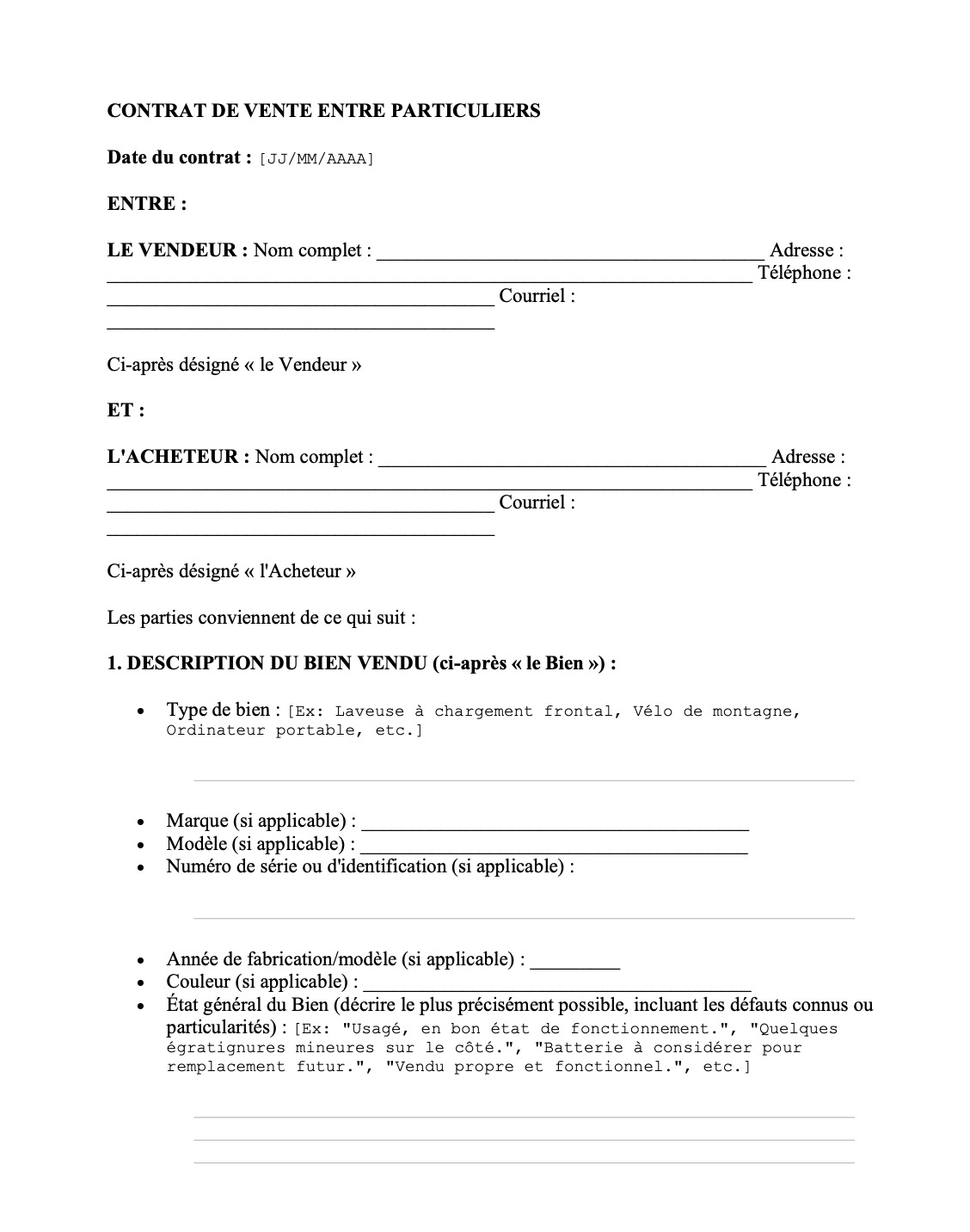
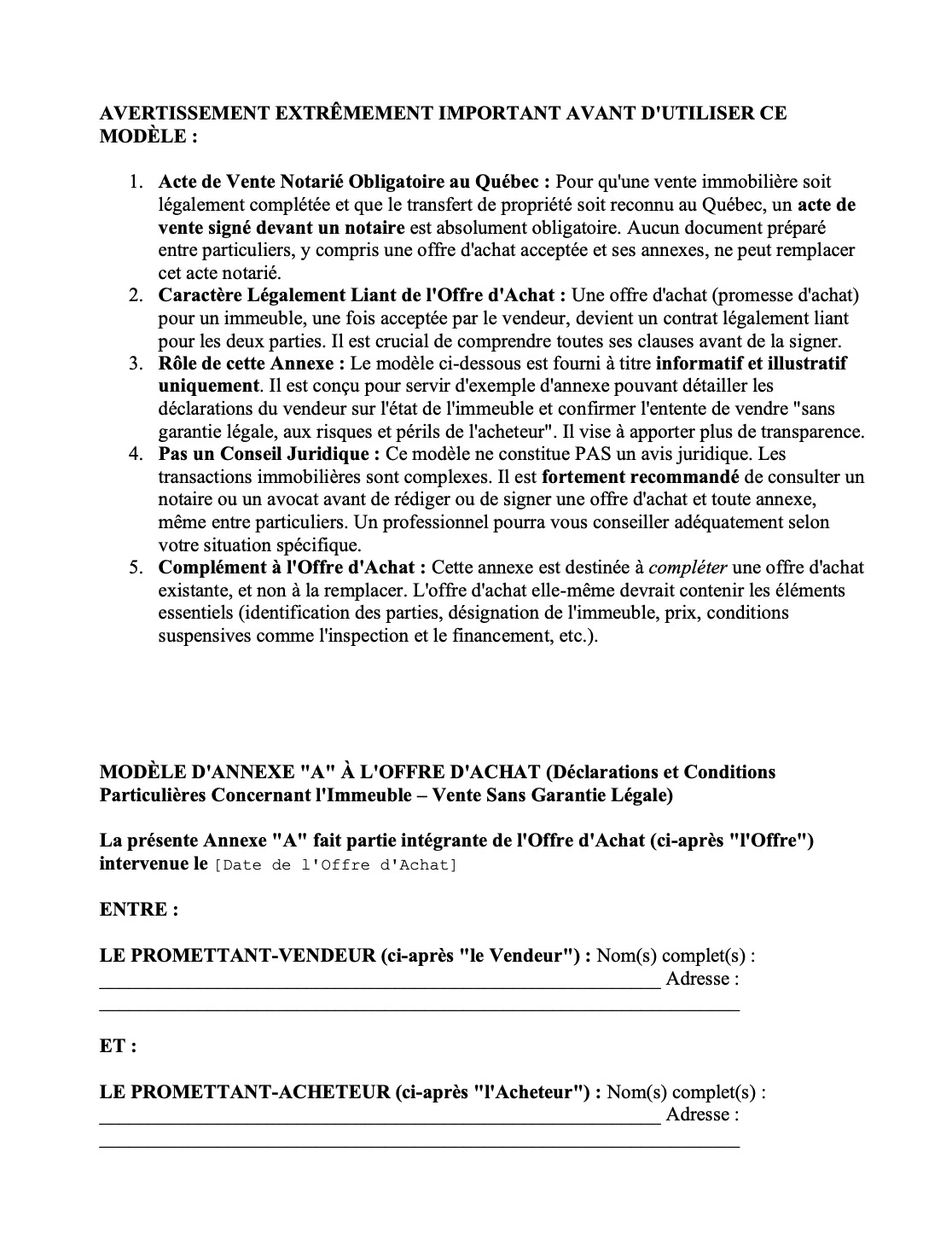
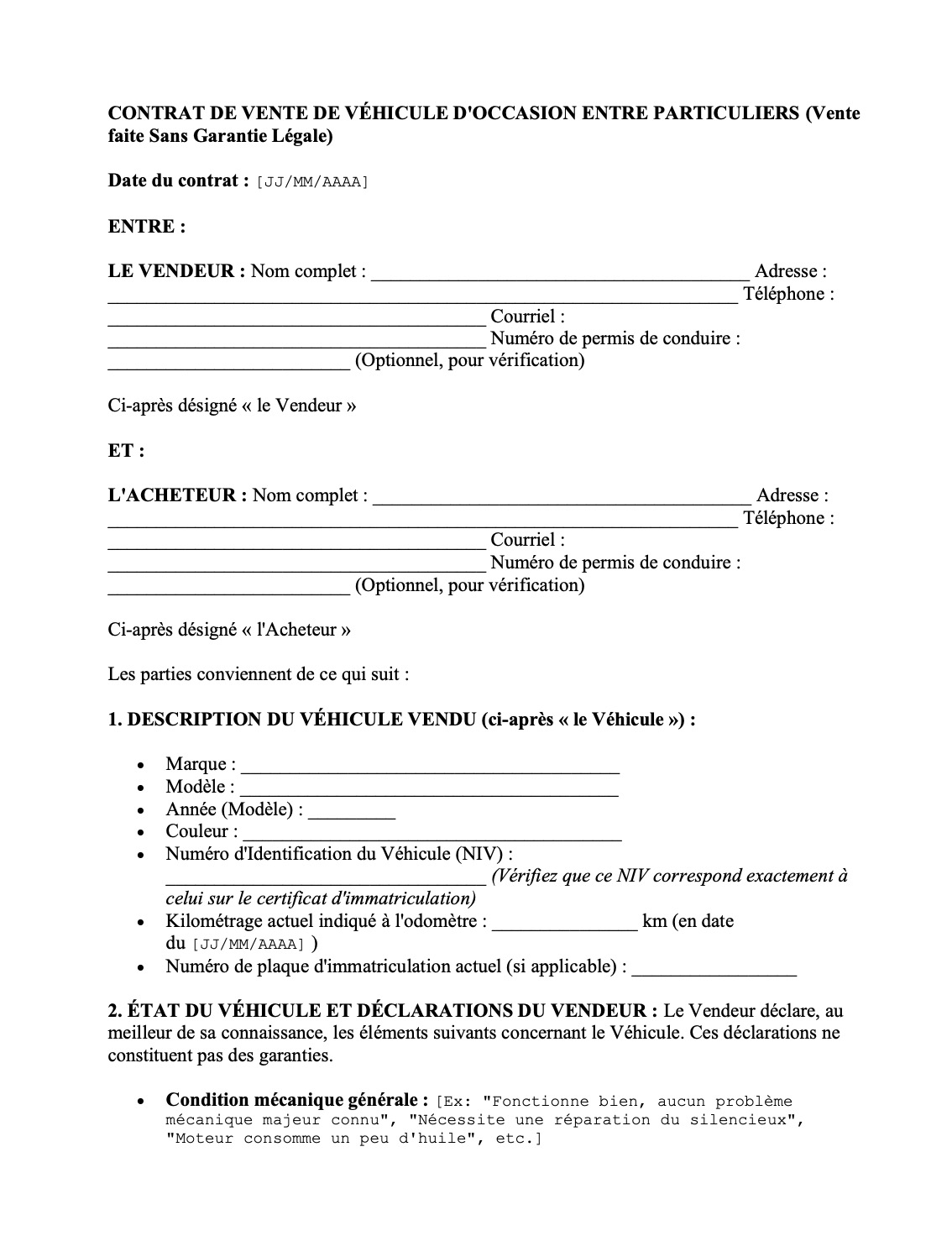
Table of Contents:
- What is the legal warranty?
- Why sell a good without a legal warranty?
- How to legally exclude the legal warranty in a sales contract?
- What does buying a good "as is" really mean?
- Can the buyer sue the seller despite the exclusion?
- What remedies are available to the buyer of real estate?
- The role of the pre-purchase inspection in a sale without legal warranty
- Sale without legal warranty by a merchant: is it possible?
- When to consult a lawyer or real estate broker?
- Conclusion
What is the legal warranty?
In Quebec, the Civil Code provides a fundamental protection for the buyer of a good: the legal warranty. It applies automatically to most sales (unless it is validly excluded) and constitutes a legal obligation for the seller.
It ensures that the purchased good is free of defects at the time of the sale.
A latent defect is a serious defect that renders the good unfit for the use for which it is intended or that so diminishes its usefulness that the buyer would not have bought it, or would not have paid so high a price, had he known of it.article 1641 of the Civil Code of Quebec
Note that the legal warranty does not cover apparent defects, that is, defects that a prudent and diligent buyer could have detected during a reasonable examination of the good before purchase.
Article 1726 CCQ
The seller is bound to warrant the buyer that the property and its accessories are, at the time of the sale, free of latent defects which render it unfit for the use for which it is intended or which so diminish its usefulness that the buyer would not have bought it or would not have paid so high a price if he had been aware of them.
However, he is not bound to warrant any latent defect known to the buyer or any apparent defect; an apparent defect is a defect that can be perceived by a prudent and diligent buyer without having to resort to an expert.
Why sell a good without a legal warranty?
Several reasons can motivate a seller, often an individual, to want to sell without legal protection. This frequently happens in the following cases:
- As part of an estate, where the heirs do not know the real estate or good well and do not wish to assume responsibility for potential latent defects.
- For a good requiring major renovations or showing signs of dilapidation.
- Simply to avoid potential lawsuits related to issues one is not aware of.
In all cases, the seller clearly signals that he is not guaranteeing the future or hidden condition of the good, prompting the greatest caution and urging a thorough inspection.
How to legally exclude the legal warranty in a sales contract?
For a sale to be considered made without a legal warranty, this exclusion must be clearly and explicitly stated in the sales contract (usually the notarial deed of sale for real estate). A mere verbal mention is not enough; the exclusion clause must be written in black and white in the document that will bind the parties. This is an essential legal condition for the exclusion of remedies to be legal and valid in Quebec.
The wording used is crucial. Expressions such as:
- "sale made without legal warranty, at the buyer's risk and peril"
- or
- "the seller provides no legal warranty on the good sold"
are commonly used. The mention must be clear, precise and unambiguous to leave no doubt as to the parties' intention to exclude the legal warranty.
Tips to avoid mistakes
It is important to understand that this exclusion must be specifically mentioned in the final deed of sale. A mention in a offer to purchase may not be enough if it is not carried over into the notarial deed.
What does buying a good "as is" really mean?
When a sales contract states that the good is sold "at the buyer's risk and peril", this essentially means that the buyer accepts the good as is. That is, in the condition in which it is at the time of the transaction, with all its potential defects or latent defects, whether known or unknown to the seller (except in cases of fraud).
The buyer therefore assumes a much higher risk than in a standard sale. Buying a good as is implies that the buyer waives, in principle, the usual remedies against the seller.
It is therefore important to consider the potential repair or renovation costs, and to factor this risk into the decision to buy and the price paid for the good.
Can the buyer sue the seller despite the exclusion?
Yes, but the grounds are limited and the bar is high. As mentioned earlier, even with a sale-without-legal-warranty clause, a buyer retains the ability to sue the seller if:
- He can demonstrate that the seller committed fraud. Fraud, in Quebec civil law, involves a fraudulent manoeuvre, concealment or intentional lie on the part of the seller.
To succeed, three essential elements are required:
- the existence of a serious latent defect prior to the transaction
- the seller's knowledge of this defect before the transaction
- the seller's intention to deceive the buyer (either by silence or by providing false information).
Gathering this evidence can be difficult and often requires the involvement of experts and a lawyer.
If fraud is proven, the buyer can request the cancellation of the sale, a reduction of the purchase price, or damages to cover repair costs and other losses suffered.
This is then a remedy based on the seller's civil fault (fraud). Buying with an exclusion of warranty greatly limits the power to seek recourse, but does not completely eliminate it in cases of proven bad faith on the part of the seller.
What are the possible remedies for the buyer of real estate?
When buying real estate without a legal warranty, the buyer's remedies in the event of problems discovered after the purchase are considerably reduced. The main remedy that remains is an action in court based on the seller's fraud, as explained earlier.
A remedy for fraud aims to obtain compensation for the damage suffered. The buyer could request the cancellation of the sale of the real estate (returning the parties to the state they were in before the sales contract), a reduction of the purchase price equivalent to the decrease in value caused by the defect or the cost of necessary repairs, or damages for the inconvenience and expenses incurred (expertise, lawyer, etc.).
Succeeding in this type of remedy against the seller in the case of a concealed defect requires solid evidence.
The role of the pre-purchase inspection in a sale without legal warranty
The pre-purchase inspection by a qualified professional becomes even more important than it already is in a standard transaction. Indeed, it is necessary to take all possible measures to know the real condition of the good before committing to buy.
A thorough inspection makes it possible to identify apparent defects and potentially certain clues of less visible problems.
In the case of a real estate transaction, the inspector will examine the structure, roof, plumbing, electrical system, heating, insulation, presence of moisture or mould, etc. His detailed report will provide a better idea of the condition of the good, the immediate or future repair work to be planned, and the potential risks associated with the acquisition. It is a significant step.
Attention
The inspector cannot guarantee the discovery of all defects and problems (some may be impossible to detect without destructive work).
Armed with the information from the report, the buyer can decide to proceed with the purchase while being aware of the risks, negotiate the price downward to account for the identified defects, or even withdraw from the transaction if the problems raised are too significant.
Sale without legal warranty by a merchant: is it possible?
There are a few very specific exceptions in the law, but the general rule is clear: selling without any legal warranty is mainly a practice encountered in transactions between individuals. If you buy a good (new or used) from a merchant, you generally benefit from the legal protection, even if the sales contract tries to exclude it. The law protects the individual buyer here. A merchant cannot simply decide to sell "without legal warranty" to a non-professional in order to escape his obligations.
A mention of "final sale" or "as is" used by a merchant does not release him from legal protection. These terms may mean that the merchant does not accept returns or exchanges for reasons of personal convenience (wrong size, change of mind), but they do not void the legal warranty if the good is defective.
When to consult a lawyer or real estate broker?
Given the significant legal and financial implications, it is strongly recommended for both the buyer and the seller to consult professionals before concluding the transaction. A lawyer specializing in real estate law or an experienced real estate broker can provide essential legal and practical advice. These transactions can be complex.
For the buyer, a lawyer can review the offer to purchase and the deed of sale to ensure that the exclusion clause is legally valid and explain all of its consequences. He can also advise on the importance of the inspection and on the potential remedies (or their absence).
A real estate broker can help assess whether the price requested for the good without legal warranty is fair given the risks assumed and guide the buyer through the purchase process. Contacting a lawyer is a wise precaution.
For the seller, a lawyer or notary will ensure that the wording of the exclusion clause in the sales contract is clear, precise and compliant with the law in order to effectively exclude his obligations and minimize the risk of future lawsuits.
A real estate broker can help him establish a realistic selling price for an "as is" property and manage the negotiations. Navigating a real estate transaction without the help of a competent lawyer or real estate broker considerably increases the risk of costly errors or disputes. Their advisory power is valuable.
Conclusion
By understanding these points well, buyers and sellers can approach a sale without legal warranty in a more informed and safer way.